Showing posts with label shared custody. Show all posts

14.4.13

A Nation of Motherless Children? Father's Rights

·

A Nation of Motherless Children? | Janie McQueen, Author and Divorce Gamesmanship Expert

A Nation of Motherless Children?
http://janiemcqueen.com/a-nation-of-motherless-children/

"In some of the more severely manipulated cases, the tables were turned on mothers who sought to protect their children from abusive fathers; they were punished in family court and by the abusive parent.

Many are limited to a couple hours’ supervised visitation every two weeks. They don’t have the privilege of shaking on the bleachers with the rest of us, who naturally take such excursions for granted. Many times there’s a protective order that would keep them from attending even public events such as this, when all they long to do is see their children in action, and enjoy a game to break up a brutal week of missing their children.

...What kind of man goes to every length and expense possible to deny his children a healthy, some would say critical, portion of motherly love in their lives? Or not even that–what kind of man begrudges his ex any meaningful contact with her own children? Is this not evidence he could be lacking as a father? If not, why? Sorry about that failed relationship, man, but the children from it remain. Lucky you to have a magic wallet to make it all go away.

It’s time to stop treating kids as chattel instead of children."

Janie McQueen's Book on How Family Court Is A Game:
Hanging On By My Fingernails: Surviving the New Divorce Gamesmanship, and How a Scratch Can Land You in Jail

In this daring, groundbreaking book, journalist Janie McQueen unveils the truth behind the "new divorce gamesmanship"--vicious tactics that thrust victims into complex webs of legal tangles that destroy spirits and hobble divorce cases.

These surprisingly common--and legally deadly--ploys can and often lead to criminal charges and trials, lingering records, heartbreaking child custody battles, embarrassing distortion campaigns, and even unemployment as employers increasingly trawl the Internet for background checks.

16.5.12

Speaking of KS Case Managers - Dr. Milfred ‘Bud’ Dale – Submits Amicus To Appellate Court – Case Manager Bud Dale’s Report To Court and his Comments on Private List Serve About the ‘gravy train’ wagon. In His Own words…..

·


Dr. Dale Case Manager Report to Court in the Claudine Dombrowski Case;

“..forcing a battered mother to not complain about sexual and physical abuse - it’s confrontational, and if mommy wants to see child again.. then mommy will do as told.”

2002 april 2 dr. dale evaluation forensic ordered by court to get mom out of SV from Dec. 2000 ex-parte order


In Bud Dale’s OWN WORDS Courtesy of TheLizLibrary Psychology in Family Court

Case Managers; CUSTODY EVALUATORS
AND  PARENTING COORDINATORS
IN THEIR OWN WORDS

Therapeutic Jurisprudence - What's wrong with our family courts - NNFLP research on custody evaluation practices

What Litigation Abuse Looks Like! It Boggles The Mind That Each ...

A Topeka Kansas Evaluation: Teaching the mother to NOT REPORT sexual or physical Abuse: As Ordered by the Courts;

 Dr. Milford “Bud” Dale.


9. For example, the below commenting MHP — who has been a parenting coordinator (“case manager”)

on at least one case known to the author in which a severely battered woman lost custody of her daughter to the abusive father,and who regularly performs custody evaluations as well — appears oblivious to the impact of MHP fees (which typically are divided equally between the parents) on a parent with substantially lower income than the other:

[ANONYMOUS LISTSERVE COMMENT]: “If you want the parents to cooperate, why not add a provision that they must go back to mediation or to a parent coordinator if they cannot come to an agreement. As long as the mediator or parent coordinator changes a reasonable fee, the financial incentives for the parents to cooperate is maintained (assuming each wants to avoid paying a mediator or parent coordinator) and there is a solution for persistent disagreements that is fair…” (Kansas doctorate-level MHP, October 24, 2005).

More examples:


[ANONYMOUS LISTSERVE COMMENT]: “…issues of child support are totally separate from custody and parenting time determinations. Yet in one case… the attorney continually referenced the fact that I was ‘failing to consider and give weight’ to the fact that the father was $20,000 behind in child support… Fortunately, my appointment letter addressed that my role was separate from the financial issues… Indeed, I had not failed to give weight to the financial issues. I had totally ignored and disregarded them all along – because that’s what I was required to do by law. Some attorneys will attempt to backdoor this issue; that is, they will claim that the child support arrearage represents a character flaw or defect – which might or might not be true. By the way, researching the literature about how fathers get so behind in child support yields some interesting claims on both sides of the issue.”(Kansas doctorate-level MHP, February 12, 2006).

[ANONYMOUS LISTSERVE COMMENT]: “…issues of child support are totally separate from custody and parenting time determinations. Yet in one case… the attorney continually referenced the fact that I was ‘failing to consider and give weight’ to the fact that the father was $20,000 behind in child support… Fortunately, my appointment letter addressed that my role was separate from the financial issues… Indeed, I had not failed to give weight to the financial issues. I had totally ignored and disregarded them all along – because that’s what I was required to do by law. Some attorneys will attempt to backdoor this issue; that is, they will claim that the child support arrearage represents a character flaw or defect – which might or might not be true. By the way, researching the literature about how fathers get so behind in child support yields some interesting claims on both sides of the issue.”(Kansas doctorate-level MHP, February 12, 2006).

72.The reason for this has been decades of MHP lobbying and propagandizing to the legislatures and legal community.

[ANONYMOUS LISTSERVE CALL TO ARMS]: “There is a new bill in the California state legislature which will be of some interest and concern to all of us who do custody evaluations, especially California psychologists. The bill prohibits the use of psychological testing in custody evaluations unless the court grants “a motion for a mental or psychological examination of a parent only for good cause shown…” (California doctorate-level MHP, February 23, 2007).
[ANONYMOUS LISTSERVE COMMENT]: “…The legislator is sponsoring this bill on behalf of women’s rights groups, who think that parental alienation is diagnosed too frequently through the use of psychological testing…” (California doctorate-level MHP, February 23, 2007).
[ANONYMOUS LISTSERVE COMMENT]: “This bill appears to prohibit considerably more than psych testing… “Controversial, nonscientific labels, such as parental alienation syndrome, parental alienation, or alienated child, are specifically excluded as allowable diagnoses and for court use.” (California doctorate-level MHP, February 23, 2007).
[ANONYMOUS LISTSERVE COMMENT]: “I am responding from a strategic and tactical point of view. In addition to being a forensic psychologist, doing CCE, I am also legislative chair of the Florida Psychological Association. In my experience…” (Florida doctorate-level MHP, February 23, 2007).
[ANONYMOUS LISTSERVE COMMENT]: “I’ll go ahead and forward this to her if that’s ok with you.  the annual Legislative and Advocacy day is coming up mid-March, altho I’m guessing they’ve already selected the legislation they want psychologists to discuss with legislators… do you know how far along this bill is in the legislative process… I think CPA’s stand in general is to strongly oppose any bill that limits psychologists’ scope of practice…” (California doctorate-level MHP, February 23, 2007).
[ANONYMOUS LISTSERVE COMMENT]: “Perhaps a letter from those of us who write and teach about use of psychological tests in CCEs might be useful?…” (North Carolina doctorate-level MHP, February 23, 2007).
[ANONYMOUS LISTSERVE COMMENT]: “I agree also and think a letter from professionals that know testing is a great idea.  It seems that if the legislature wants to “do something”  perhaps advocating for  required continuing education of so many hours in order to allow people to use the tests…” (Kansas doctorate-level MHP, February 23, 2007).

115. http://www.thelizlibrary.org/liz/index.html#myths-and-facts

116. As is usually recognized by the MHP, e.g. Pickar, supra, note 66b, but only when convenient or desired. Compare the following.

The first two commentators are uninterested in acknowledging past financial issues that have wreaked family havoc, and arguably bear on character as well as explain motives and feelings of the parties; the third is interested in supporting a father’s request to relocate, and so believes that it is within his province to gather and analyze data about prospective financial matters:

[ANONYMOUS LISTSERVE COMMENT]: “Tax returns?? Simple issues like one parent claimed 4 kids and there are only two, I can probably figure that out and that speaks to honesty and maybe tracking reality. But I agree that we should not be analyzing tax issues. If it is that complex I can’t think how that would be relevant to custody/parenting issues. If it is, both parent provide information and you hire a tax consultant to review it. I can’t imagine what could be relevant… I have a case right now where there are federal indictments on one parent to the tune of over 1/2 millions and all kinds of issues around money. Very little of it is relevant (except possible prison and honesty) and the other parent wants to make it all relevant. She brought me a notebook of financial records. That’s about her anger about the money – which is relevant to know how angry she is at dad and how that affects her children.”(Kansas doctorate-level MHP, November 23, 2005).

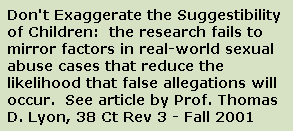
Child Custody Evaluations - Thomas D. Lyon article on the suggestibility of children124. For an example of how background might influence the MHP’s investigation, perceptions and conclusions, see Lisa D. Cromer & Jennifer J. Freyd,What Influences Believing Child Sexual Abuse Disclosures? The roles of depicted memory persistence, participant gender, trauma history, and sexism, 31 Psych. Women Q. 1 (2007). From the abstract: “Men believed abuse reports less than did women, and people who had not experienced trauma were less likely to believe trauma reports. Gender and personal history interacted such that trauma history did not impact women’s judgments but did impact men’s judgments. Men with a trauma history responded similarly to women with or without a trauma history. High sexism predicted lower judgments of an event being abusive. Hostile sexism was negatively correlated with believing abuse disclosures.” The study at the University of Oregon found that “young men who have never been traumatized are the least likely population to believe a person’s recounting of child sexual abuse.” (News release, Believing child sexual abuse claims, U. Or. Univ. News, February 13, 2007, at http://www.uoregon.edu/newsstory.php?a=2.13.07-disbelievers.html)

[ANONYMOUS LISTSERVE PRECURSOR]: “I just haven’t noticed higher abilities in hypothesis testing among psychologists or other mental health professionals. I realize that you have to take a couple of courses in research and statistics to get a graduate degree (in most fields). It doesn’t seem to translate into skills in decision-making across the board. E.g. the recent thread on the Kansas custody evaluation and Virginia side trip. Some very off thinking and relevant point missing.
One might take arguments similar to that you have made and point out that psychologists just aren’t trained as investigators when it comes to obtaining information outside of psychological data (police officers are better.) And that lawyers are better trained at issue spotting and weighing information. And that judges have more experience decision-making.
I also point out that mental health training does not provide actual information and experience relevant to many of the issues that ought to be considered in a custody determination. For example, the financial aspects. For example, educational opportunities. For example, what it’s like to actually be a parent with day-in and day-out responsibility for children, how the home is run, the pragmatics of life. An unwed childless 28-year-old Ph.D. just out of school probably hasn’t a clue — and I for one see this lack influencing unworkable recommendations.
I also point out that skill in testing and coming up with psychological diagnoses does not qualify anyone ipso facto to translate that into parenting ability or even to understand with what kind of or which parent a child’s best interests is most likely to be fostered. There is very little translating dsm diagnoses into parenting abilities and child outcomes, especially when neither parent is perfect and foibles and personality defects have to be weighed…” (liz, May 2, 2005).

124. For an example of how background might influence the MHP’s investigation, perceptions and conclusions, see Lisa D. Cromer & Jennifer J. Freyd, What Influences Believing Child Sexual Abuse Disclosures? The roles of depicted memory persistence, participant gender, trauma history, and sexism, 31 Psych. Women Q. 1 (2007). From the abstract: “Men believed abuse reports less than did women, and people who had not experienced trauma were less likely to believe trauma reports. Gender and personal history interacted such that trauma history did not impact women’s judgments but did impact men’s judgments. Men with a trauma history responded similarly to women with or without a trauma history. High sexism predicted lower judgments of an event being abusive. Hostile sexism was negatively correlated with believing abuse disclosures.” The study at the University of Oregon found that “young men who have never been traumatized are the least likely population to believe a person’s recounting of child sexual abuse.” (News release, Believing child sexual abuse claims, U. Or. Univ. News, February 13, 2007, athttp://www.uoregon.edu/newsstory.php?a=2.13.07-disbelievers.html)

125. [ANONYMOUS LISTSERVE QUERY]: “My 8 year old son is complaining a lot about being bored in school, to the point it seems to be affecting his overall happiness… I experienced similar problems throughout elementary and high school.. Will talk with the school but am seeking ideas to help him cope…” (Doctorate-level MHP father, April 21, 2005).

[ANONYMOUS LISTSERVE COMMENT]: “While such “purity balls” are not something that I and my daughters (ages 14 and 12 next week) have ever or would ever participate in, I can indeed tell you that as a father I feel a desire to help protect my daughters from predators and even poor choices on their part.” (Idaho doctorate-level MHP father, April 19, 2006).
[ANONYMOUS LISTSERVE COMMENT]: “I asked my stepdaughter what stores my granddaughter likes… One of the stores she mentioned was Victoria’s Secret. Why would a high school junior want to buy anything in Victoria’s secret? Has it changed in terms of what it sells? I know they all like to dress like streetwalkers, but this is ridiculous.” (Minnesota masters-level MHP mother, February 28, 2005).
[ANONYMOUS LISTSERVE COMMENT]: “School is important for kids… why not look and take the time to get good data from people who see them more than we do? And who see them sometimes more than their parents do. I’m going to stop now and call my son’s school. Seems there is an academic counselor… who is helping my son with sending emails to college soccer coaches. She’s helping my son and deserves my support… the students at school call this counselor, “Momma.” And I know why. Aren’t some kids just luckier than others?” (Kansas doctorate-level MHP father, May 10, 2005).

…When There Still Isn’t Enough Work, Doing Trainings for Everyone (especially those that push make-work ideas) and Reviewing Other MHPs

[ANONYMOUS LISTSERVE COMMENT]: “I do CCEs and I function as a court-appointed “Case Manager” in Kansas. Kansas calls parent coordinators “Case Managers” to avoid confusion – lol. I have also twice attended AFCC sponsored training on parent coordination. The Colorado group (Christie Coates, Robert LaCrosse, And Betsy Duvall) did a 2 day training in St. Louis in November, 2003, and Joan Kelly did a 2 day training in Chicago in June 2004. Both of these training programs emphasize the “Divorce Impasse” Model that Janet Johnston put together. This is a model that I find helps in CCEs and parent coordination/case management. The second AFCC task force has just completed its task of developing model standards for parent coordinators (See AFCC website or request backchannel)…” (Kansas doctorate-level MHP, May 16, 2005).

“Do a Bonding Assessment”

[ANONYMOUS LISTSERVE COMMENT]: “I do not know of a research based protocol for a ‘bonding assessment.’ It seems the folks that do them around here do an observation of touching, smiling, eye contact, warm interactions etc which are good and important and look at basic needs and are they met. I was wondering if there are protocols that are considered ‘standard of care’ and or are reseach based.” (Kansas doctorate-level MHP, January 14, 2007.)

For more about the GREAT Dr. Milford “Bud” Dale please visit the following links.

http://www.thelizlibrary.org/therapeutic-jurisprudence/index.html

http://washburnlaw.edu/news/2009/2009-03cflc-horizons.php

KANSAS CASE MANAGERS; CHILD CUSTODY COURT APPOINTED 3RD PARTIES, PSYCHOLOGY; CUSTODY EVALUATIONS; THERAPY, GAURDIAN AD LITEMS, COPARENTING, SUPERVISED VISITATION, ACCESS VISTITATION and ‘Therapeutic Jurisprudence’.

·

Therapeutic jurisprudence in the family courts, i.e. a "mental health approach to the law" substitutes the opinions of mental health practitioners for traditional evidence and decision-making procedures. Because these persons actually do not have any kind of "expertise" to opine this way, what originally was thought to be a helpful idea (in this medicalized and psychologized world) has become merely economic opportunism, harming not only the litigants and children in the system as well as the court system itself, but also perverting substantive and procedural law. It is not science, but compensated yenta-ism that has permeated the courts under the pretexts that engineering family affectional relationships is within the ability of mental health "science" practitioners to accomplish, and that this is an appropriate goal of the government, court system, and state police power because children "need" something it has to offer.

This completely denies the Constitutional Right to a Court of Law governed by FACT.

Mother Speaks On Case Management Bill

Source: Topeka Capitol Journal

Karen Williams, left, and her husband, Stan, talk to the media Tuesday outside the Statehouse. Williams is fighting a Douglas County case manager's decision to restrict access to her daughter, of whom Williams formerly had full custody.  ANDY MARSO/THE CAPITAL-JOURNALExcerpt;

Karen Williams previously had full custody of her daughter before a case manager appointed by the court to work with her and her ex-husband decided to limit her to one or two hours a week of supervised visitation at a Lawrence facility called The Farm.”

“Williams says her rights to due process were violated when the judge allowed the new custody arrangement without giving Williams a full hearing to respond to any evidence for the case manager's decision.

"I still have parental rights, supposedly, but effectively I've been stripped of them," Williams said.

Williams stopped by the Statehouse on Tuesday after her case was heard by the Kansas Court of Appeals. Continue Reading


 Caesars Ghost A Commenter sums it up well:

In any other area of law

In any other area of law "confidential conversations between judges and case managers" would constitute ex parte communications that would subject the parties-- including the Judges-- to disciplinary procedures and possible sanctions. This is a joke to provide such exceptions to the due process rights of either parent, as well as the rights of the children whose custody and visitation is being determined by the court.

If the Judges don't want to do their job and wish to abdicate their role to "case managers" then perhaps the Judges need to step down and be replaced by Judges who do want to do their job of hearing all of the facts in a case in full light, view and scrutiny of the opposing parties.

The 6th amendment grants criminals the right to confront their accusers and to be presented with the claims and evidence against them and the right to contest those claims and evidence.

Why does our legislature grant fewer rights to parents than they do to criminals, pedophiles, murders, etc.? And why are children denied access to parents based on what a case manager says.

I don't care if the case manager has specialized training in psychology, family therapy, domestic issues or anything else. That specialty gives the case manager nothing more than "expert witness" status constitutionally speaking. It does NOT make that case manager the default judge.

The best way to fix this is not to revise the statute and required qualifications to serve as a case manager. The best way to fix it would be to repeal the statute that created case managers in the first place and go back to how Kansas handled these cases for nearly a century and a half prior to 2002.

The whole case manager position never existed in Kansas before 2002, and so it isn't like this is just something that HAS to exist for Courts to function. Instead it is part of the reason courts are NOT functioning for families or for those who believe in due process principles of the Constitution or for those of us who abhor seeing more tax dollars going to create quasi authority figures by turning expert witnesses into defacto unlicensed judges while we continue to pay the salaries of both the abdicating judges and the defacto unlicensed judges.


PSYCHOLOGY; CUSTODY EVALUATIONS; THERAPY, CASE MANAGERS, GAURDIAN AD LITEMS, COPARENTING, SUPERVISED VISITATION, ACCESS VISTITATION

Case Managers; Forensic Psychology; Guardians ad Litem; Therapeutic Jurisprudence
The sociological and psychological research on families and child well-being impacts public policy and the issues of child custody in family law. The research frequently is misrepresented, and mis-cited by mental health professionals, lawyers, forensic psychologists and others, as well as interest groups lobbying for laws. Also review the sections pertaining to the issues impacted by the "therapeutic jurisprudence", such as child custody, parental alienation theory, research pertaining to child development, the subsection for research Myths and Facts in FAMILY LAW, and other family law issues. Also see the subsection on Child Custody in FAMILY LAW. The Therapeutic Jurisprudence index page contains links to recommended off-site locations as well as the on-site articles http://www.thelizlibrary.org/liz/child-custody-evaluations.html

Index: Therapeutic Jurisprudence

  • Are Psychologists Hiding Evidence? A Need for Reform by Lees-Haley and Courtney SCHOLAR
  • Child Custody Evaluations and Measuring Attachment (limited science) by Jean Mercer 2009 PDF SCHOLAR
  • Child sex abuse, the limits of Loftus, and overblowing the memory research LIZNOTES, CITES
  • Children's Associational Rights: Why less is more by Emily Buss PDF SCHOLAR
  • Collaborative Law: What's Wrong with Multidisciplinary Practice? by liz
  • Court-appointed Parenting Evaluators: The Case for Abolition by Margaret Dore PDF SCHOLAR
  • Custody Evaluations: Ten Signs of Questionable Practices by Joel V. Klass, M.D. SCHOLAR
  • Custody evaluators' arguments about test records -- and why they're wrong by liz
  • Custody Evaluators' Beliefs About Domestic Abuse Allegations, U.S. Dept Justice October 31, 2011 PDF SCHOLAR
  • Caveat: recommendations in the above paper are NOT endorsed by thelizlibrary.org
  • Disciplining Divorcing Parents: Social Construction of Parental Alienation by F. Besset PDF SCHOLAR
  • Family Court is Not a Family-Friendly Place by Lisa Marie Macci, Esq.
  • Guardians ad Litem in Custody Litigation: The Case for Abolition by Richard Ducote PDF SCHOLAR
  • Parental Alienation Syndrome -- getting it wrong in child custody cases by Carol S. Bruch PDF SCHOLARChildren Need. . . THIS? A custody evaluation by Martha C. Jacobson, sadistic and stupid PAS 'therapy' by Laura C. Hohnecker
  • Parenting Coordination Issues by liz
  • Psychiatric experts assess parental alienation by David Crary
  • Psychology in Court: A Trial Within a Trial by liz
  • Psychology in Court: The Detectives by liz
  • Psychology in Court:The Diagnosticians by liz
  • Psychology in Court: Discovery of Test Data by liz
  • Psychology in Court: How to Respond to the MMPI-2 by liz
  • Reevaluating the Evaluators (overview of the problem) by liz CITATIONS TO RESEARCH
  • Custody Evaluator Quotes by liz (companion to above article)
  • Signs of a Bad Custody Evaluation by Joel V. Klass, M.D. SCHOLAR
  • Socialization, Personality Development, and the Child's Environments by Judith Rich Harris SCHOLAR
  • Sound Research or Wishful Thinking in Custody Cases? by Carol S. Bruch PDF SCHOLAR
  • Stupidity Inherent in Promoting Supervised Visitation Centers by liz
  • Troubling Admission of Supervised Visitation Records in Court by Stern/Oehme PDF SCHOLAR
  • What Does the Guardian ad Litem do in Family Court? by liz
  • Warren Farrell Does a Custody Evaluation by liz
  • What's Wrong with Parenting Coordination by liz
  • Why "Therapeutic Jurisprudence" Must Be Eliminated From Our Family Courts by liz
  • Why "Therapeutic Jurisprudence" Must Be Eliminated From Our Courts by liz (pub. version)
  • Critical Assessment of Child Custody Evaluations by Emery, Otto, Donohue off-site PDF SCHOLAR
  • 27.9.09

    'If batterers presented as batterers, nobody would date them or marry them'

    ·


    Domestic violence: Damas case shows how beloved friend can become ...
    Naples Daily News - Naples,FL,USA
    “If batterers presented as batterers, nobody would date them or marry them,” Oberhaus ... including figuring out who would get custody if there are kids and ...

    Damas Family Homicide Investigation: Day 6; Sept. 24, 2009

    Previous1 of 3Next

    Damas Family Homicide Investigation: Day 5; Sept. 23, 2009

    Previous1 of 10Next

    Evidence photos: Guerline Damas
    • Photos of Guerline Damas taken on January 5, 2009 by a member of the Collier County Sheriff Office to be submitted as evidence. According to the sheriff's office the photos are of injuries Guerline sustained during a domestic disturbance between her and her husband of 10 years, Mesac Damas.  Damas was charged with battery.
    • Photos of Guerline Damas taken on January 5, 2009 by a member of the Collier County Sheriff Office to be submitted as evidence. According to the sheriff's office the photos are of injuries Guerline sustained during a domestic disturbance between her and her husband of 10 years, Mesac Damas.  Damas was charged with battery.
    • Photos of Guerline Damas taken on January 5, 2009 by a member of the Collier County Sheriff Office to be submitted as evidence. According to the sheriff's office the photos are of injuries Guerline sustained during a domestic disturbance between her and her husband of 10 years, Mesac Damas.  Damas was charged with battery.

    Previous1 of 3Next

    Documents
    BOOKMARK DAMAS SECTION

    FULL COVERAGE: Click here and bookmark this link for the latest and archived video, photos, stories and timeline about the Mesac Damas at naplesnews.com/damas

    WHERE TO FIND HELP

    Collier

    ■ Shelter for Abused Women and Children: www.naplesshelter.org or call (239) 775-3862. If you are in a domestic violence situation, call the shelter’s 24-hour crisis line (239) 775-1101.

    Lee

    ■ Abuse Counseling and Treatment: www.actabuse.com or call (239) 939-2553. If you are in a domestic violence situation, call the shelter’s 24-hour crisis line (239) 939-3112.

    NAPLES — It’s a very slow process.

    That’s how Melissa Dias described how a woman goes from partner to domestic violence victim.

    The process answers the question many Southwest Floridians asked as the news of the death of Guerline Damas and her five children spread and the family’s history of domestic violence came to light.

    Mesac Damas, 33, is accused of recently killing his wife, Guerline Dieu Damas, 32, and their children Meshach “Zack” Damas, 9; Maven, 6; Marven, 5; Megan, 3, and Morgan, 19 months, by slitting their throats and stabbing them. Court records show there was prior abuse in the home.

    So why did she stay?

    The truth, experts and advocates agree, is not as simple as picking up your bags and walking out.

    Women don’t go into relationships thinking they are going to be abused, said Linda Oberhaus, executive director of the Shelter for Abused Women and Children in Collier County.

    “If batterers presented as batterers, nobody would date them or marry them,” Oberhaus said.

    Both Dias and Oberhaus said that it’s only once trust is established -- between the couple -- that abusers begin to show signs of possible domestic violence.

    “I think that’s important,” Oberhaus said. “If he abused her on the first date, she would not have dated him.”

    With many victims of domestic violence, Dias said, they saw the first sign of abuse but didn’t recognize what it meant.

    “They realize something is wrong but they don’t know what it is,” Dias said.

    Dias is a member of the National Coalition Against Domestic Violence and has been affiliated for seven years with the Naples shelter. She now writes a blog about domestic violence.

    Verbal abuse is usually the first step an aggressor takes against the victim, Oberhaus said.

    “It happens so frequently, that they are really reduced to nothing,” Oberhaus said of the emotional abuse. “It’s almost like brainwashing.”

    Simple attacks like “You’re dumb” or “You’re fat” to “Nobody will love you” and “You can’t make it without me” take an immense toll on a victim.

    Systematic isolation usually follows.

    “A stereotypical abuser won’t want her to have friends,” Dias said. “There is jealousy.”

    Women are kept isolated even from family members, so if the woman interacts with them they would still be distant and quick to sever relations if the abuser demanded it.

    “A woman slowly starts to lose her self-esteem and confidence,” she said. “Eventually physical abuse happens.”

    It’s about power and control.

    “Batterers choose who, when and where they batter,” Oberhaus said.

    And to those who say, “Batterers can’t control themselves,” Oberhaus said that’s just not true.

    “They are battering behind closed doors,” she said. “You don’t see a husband battering his wife out in public. He batters her privately. In a gut level, they know this is not OK … that this is not acceptable.”

    Abuse has a significant psychological impact on a victim.

    According to Oberhaus, research shows that as many 60 percent of battered women also reported depression.

    In addition, battered women are at greater risk of suicide and Post Traumatic Stress Disorder.

    Even so, many victims marry their abusers, Dias said.

    “You end up really feeling like you’re stuck in a situation,” Dias said. “You’ve married someone that is supposed to be with you forever.”

    Love is one of the many reasons women stay in abusive relationships and it’s the hardest thing for many people to understand, Oberhaus said.

    “You can’t leave out the fact that they probably do love their partner,” Oberhaus said.

    Between having children in common and a long history, many women also believe that they can change the man.

    And most don’t even acknowledge they’re being abused.

    Because the abuser is always blaming the other person as the one at fault, Dias said, it creeps into a woman’s psyche.

    “And eventually you believe it,” she said.

    Domestic violence victims have to consider several issues before even attempting to reach out for help to leave a bad situation, including figuring out who would get custody if there are kids and determining if they could support their family if they leave.

    “They’re afraid for their safety. They’re afraid for their children,” Oberhaus said. “They don’t want to be homeless and they need to have the ability to care for their kids.”

    It’s that need to care for the kids that can both inspire or hold back a battered woman’s attempts to leave her abuser.

    “In many relationships men are the breadwinners,” Oberhaus said. “They can easily say ‘You don’t have the resources’ and threaten to take the kids away. That is a real Catch-22.”

    Kerrin Darkow, who works with the victim help line at the National Center for Victims of Crimes, said what caught her attention in the case of Guerline Damas was that she reached out for help several times.

    “We do know that women in these situations try many different avenues to get help,” she said.

    And for a victim of domestic violence, wanting to leave and being able to leave are two quite different things.

    Fear and the fact the couple had five children between them could have contributed to her hesitance to leave.

    “It’s a pipe dream to think that she could leave with her children and be fine,” said Darkow, who added that in many domestic violence cases, abusers use children as bargaining chips to get their victims to do what they want. “Leaving an abuser does not mean you are safe from an abuser.”

    The time after a victim finally escapes the abuser is also the most dangerous time for them.

    The best thing a friend or family member who realizes someone is in a domestic violence situation can do is call the local domestic violence hot line to create a safety plan, Oberhaus said.

    “The reality is that a woman is most likely to be killed at the time that she leaves,” Oberhaus said. “And that’s a fact.”

    Dias agreed.

    “Men like to control you and scare you,” Dias said. “They will use whatever means to keep control.”

    Dias said she found a new beginning when she connected with the Shelter for Abused Women and Children in Naples.

    The shelter and others like it, she said, defy the myth that battered women’s shelters are cold, awful places.

    “It’s just given me so much confidence -- confidence I never had in my life,” Dias said of the shelter and weekly support group she has attended for nearly seven years. “It’s more like a sisterhood ... It’s been a godsend for me.”

    As for people asking, “Why does any woman stay?” Oberhaus said that it’s the wrong question to ask.

    “When someone asks, ‘Why did she stay?’ -- that is victim-blaming,” Oberhaus said. “The question should be: ‘Why would a loving father and husband emotionally or physically batter his children or partner?’ ”

    ■■■■■

    Editor’s note: Monday, the Daily News begins a series of profile stories about the Damas family victims.

    Technorati Tags: ,,,,,,,,,,,,,,,,,,,,,,,,,,,,,,,,,,,,,,,,,,,,,,,,,,,,,,,,,,,,,,,,,,,,,,,,,,,,,,,,,,,,,,,,,,,,,,,,,,,,,,,,,,,,,,,

    22.9.09

    Living The Nightmare-Why are my children dead?

    ·

    Living The Nightmare

    SUSAN MURPHY MILANO'S JOURNAL

    [blip.tv ?posts_id=2648076&dest=-1]

    Amy Leichtenberg quietly approached the casino boat gamblers with fliers, hoping they may have seen her ex-husband, a known gambler. Three weeks earlier, he abducted the couple’s two young sons and by now all other leads had come up snake eyes. Then her phone rang.

    An investigator on the case told her to drive to the McLean County Sheriff’s Department to discuss something new in the case.

    Leichtenberg excitedly made the two-hour drive to the police station, allowing herself to daydream about her two boys—9-year-old Duncan and 7-year-old Jack—happily greeting her there.

    Inside the station, she didn’t see her boys waiting for her. Instead, Beth Kimmerling, the county coroner, introduced herself.

    "No!" Leichtenberg screamed, quickly realizing her hopeful daydream turned into her worst nightmare. "No! No! No!"

    The coroner couldn’t even get the words out, telling Leichtenberg that Duncan and Jack—the joys of her life—were dead. And her ex-husband was dead, too, taking his own life after killing both his sons.

    "Where are my babies?!" Leichtenberg remembers asking frantically through sobs. "Where are my babies?!" The coroner told her the boys’ bodies were with their father’s body in the back of the police station.

    "I want my boys as far away from him as possible!" Leichtenberg remembers yelling, punching a desk and nearby concrete walls.

    As the coroner left, Leichtenberg dissolved into a chair, crying, screaming and shaking. She felt numb. She felt empty. She felt like joining her sons in heaven. "I want to see my babies," she remembers telling authorities. No, they told her. Not yet. Not now. Not in their condition.
    She begged them. They refused.

    To read the entire story about Amy Leicchtenberg in the October issue of Chicago Parent click HERE.

    Amy Leichtenberg was a guest on the Susan Murphy Milano show to listen to the interview it plays from this site automatically make sure the volume of your computer is turned on. Susan's show willresume again on Wednesday October 7, 2009 at 4:00 PM.

    POSTED BY SUSAN MURPHY MILANO'S JOURNAL AT 02:13

    LABELS: AMY LEICHTENBERG, BROKEN LEGAL SYSTEM, CHICAGO TRIBUNE,CHILD CUSTODY, CNN NEWS, JACK AND DUNCON CONNOLLY, MOTHERS IN COURT, WOMEN IN CRIME INK.

    Technorati Tags: ,,,,,,,,,,,,,,,,,,,,,,,,,,,,,,,,,,,,,,,,,,,,,,,,,,,,

    1.9.09

    Video Presenters at the Sixth Annual Battered Mothers Custody Conference: Albany NY 2009

    ·

    Sixth Annual Battered Mothers Custody Conference:

    http://bmcc6.blip.tv/


    The Sixth Annual Battered Mother's Custody Conference: "Solutions"

    Friday January 9th - Sunday 11th, 2009 Articles about the 2009 conference by professional journalists who were there:

    Commentary womensforum.com By Garland WallerJanuary 13, 2009

    The start of the New Year always fills me with hope, with plans for change, with determination. But for me, there is also an annual event that overshadows the hoopla and superficial goals. For me, the New Year heralds the Battered Mothers Custody Conference ... full article

    This is Really Hard to Believe Opinion By Barry Nolan Thursday, 15 January 2009 09:14This is really hard to believe. I am sitting in a room filled with women who were beaten, and violated in terrible ways. The room is not in Bosnia, or some far flung third-world hell-hole. I am in a function room in a hotel in Albany at the Battered Mothers Custody Conference. ... full article

    Presenters Schedule

    BMCC VI Announcement and General InformationBrochure and Mail-In RegistrationOnline Registration 2009 Co-SponsorsSilent AuctionSupport the ConferenceAbout the Conference

    Organizations and Support Resources

    Legal Resources: Articles, Research,
    Briefs, Case Law

    Contribute a Panel to the "Children Taken By The Family Courts" Community Quilt

    The Conference in PBS' 2005 Documentary

    Film: Breaking the Silence, Children's StoriesFilm: Family Court Crisis

    Testimonies filmed by Garland Waller at the 2008 conferen

    Technorati Tags: ,,,,,,,,,,,,,,,,,,,,,,,,,,,,,,,,,,,,,,,,,,,,,,,,,,,,,,,,,,,,

    Just to Hurt Mum...

    ·

    Just to Hurt Mum...

    A father who received shared parenting of the children:
    1. Left a 14yo and 9yo alone in the home to see his girlfriend regularly.
    2. Threatened to deprive them of their mother, if they told.
    3. Took all of the furniture out of the house, leaving them with a few clothes and blankets.
    4. Is relying on depression as an excuse of his negligence.
    In the article, it states:
    "Duty solicitor Mark Dollimore said the man was suffering depression, had not felt able to look after his children, and wanted to co-operate as much as he could."
    Then why did he go to the Family Court and battle it out for Shared Parenting?
    Just to hurt mum
    Why would he leave them in such poor conditions?
    Just to hurt mum
    If he could not have cared for them, why didn't he just phone the mother?
    Oh.. that's right, he is busy hurting the mother.
    Fact is that the Family Court has been and is continually used as a weapon against mothers resulting in the harm of children. 
    The people who made the shared parenting laws are bitter angry fathers who wanted the legal power to hurt not only their ex wives, but all mothers through the children.  They see them as nothing more than a commodity or a tool to use and spout their hatred for all women. 
    Through the same charm and wit they used to lure these women into destructive environments, they used to promote this bill. 
    Hence every mother who goes through this system, is forced to endure the suffering this shared parenting mob inflicted. 
    The question is not how much suffering every mother can endure knowing that her children are at risk or are being abused and neglected.  The question is now, what is the government going to do about it?  How long do they have to endure this genocide?  How many idiots are they going to listen to before we are heard?
    No matter how much you try to bury the truth rather than act, it will not only shine through but be sure there will be justice.

    Technorati Tags: ,,,,,,,,,,,,,,,,,,,,,

    31.8.09

    Parental Alienation Syndrome Misused in Child Custody Cases, say Domestic Violence Advocacy Groups

    ·

    According to NNEDV, DV LEAP, SFV, and NCADV, victims of domestic violence face a surprisingly uphill battle in family court to win custody of and safety for their children. All too often, courts award custody and unsupervised visitation to parents found to have committed domestic abuse. Many courts handling custody cases do not understand the dynamics of domestic violence and fail to properly factor in the impact of abuse when considering the best interests of the child.


    Leadership Council Issues Statement

    Parental Alienation Syndrome Misused in Child Custody Cases, say Domestic Violence Advocacy Groups

    The National Network to End Domestic Violence (NNEDV), the Domestic Violence Legal Empowerment and Appeals Project (DV LEAP), Stop Family Violence, and the National Coalition Against Domestic Violence, four of the nation's leading domestic violence victim advocacy organizations, call on the media and the courts to rectify the misunderstanding and misuse of Parental Alienation Syndrome (PAS) in custody cases.

    "Child custody cases are among the toughest cases courts have to handle. And in custody cases where domestic violence is involved, the judges have an even higher responsibility to ensure that the safety of family members is not dangerously impaired by misleading - and legally unjustifiable - ‘parental alienation syndrome' theories," said Sue Else, president of the National Network to End Domestic Violence.

    "Parental Alienation Syndrome" is a claim that has been used to suggest that some parents try to undermine their children's relationship with the other parent, typically the noncustodial parent, by making false statements about that other parent, most often in the form of abuse allegations. In fact, actor Alec Baldwin made that claim about his own child custody case in a recent interview with Diane Sawyer.

    "PAS is being used by some abusers as a tactic to demonize parents' attempts to protect their children from abuse, denying victims of domestic violence justice in the courts. The fact that some parents behave badly in ordinary cases is no reason to ignore real abuse when it is presented to the court," also stated Else.

    Joan Meier, DV LEAP's Executive Director, said, "PAS was invented to defeat child abuse claims - and it has been remarkably successful in misleading family courts into believing that women who are sincerely trying to protect their children and themselves from abuse, are just seeking to end the children's relationship with their noncustodial father."

    According to NNEDV, DV LEAP, SFV, and NCADV, victims of domestic violence face a surprisingly uphill battle in family court to win custody of and safety for their children. All too often, courts award custody and unsupervised visitation to parents found to have committed domestic abuse. Many courts handling custody cases do not understand the dynamics of domestic violence and fail to properly factor in the impact of abuse when considering the best interests of the child.

    "The most important factor judges should be weighing in making custody decisions is the safety of the mother and children, and the introduction of PAS overshadows this critical need for safety," said Rita Smith, Executive Director of the National Coalition Against Domestic Violence.

    Meier states that research has shown that children become "alienated" from a parent for a variety of valid reasons, most often resulting from the parent's own negative behavior and relationship with that child.

    "The proponents of ‘parental alienation syndrome' are purveying invalid junk science is not even legally admissible. PAS has been emphatically rejected by the Presidential Task Force of the American Psychological Association and by the National Council of Juvenile & Family Court Judges. Leading researchers in the field of custody have agreed that PAS has no scientific validity and the only courts to address the issue have found it inadmissible," said Meier.

    "With the increased media attention surrounding the release of Alec Baldwin's book, it is important to let the public know that victims of domestic violence are being silenced through the use of ‘parental alienation syndrome.' We cannot afford to consign thousands of children to unsafe custody or visitation with abusive parents because family courts have come to believe that abuse allegations mean nothing more than a campaign of alienation," said Else.

    Technorati Tags: ,,,,,,,,,,,,,,,,,,,,,,,,,,,,,,,,,,,,,,,,,,,,,,,,,,,,,,,,,,,,,,,,,,,,,,,,,

    Technorati Tags: ,,,,,,,,,,,,,,,,,,,,,,,,,,,,,,,,,,,,,,,,,,,,,,,,,,,,,,,,,,,,,,,,,,,,,,,,,,

    28.8.09

    The Crucial importance of mother “Common Sense”

    ·


    But of course  Maternal Deprivation from mother during any time of a growing child is sadistic- I know- my daughter knows- It has been now eleven years- that we have been denied to even simply ‘hug’. –but of course it is more imperative that we ‘not tarnish the image of father’

    - after all it is not healthy for a child to see her father as the convicted bully and wife beater that he is- so- contact has been denied- to keep her from ;knowing of the violence. Thanks to the power of www-  the Silence has been broken..


    Maternal Deprivation was inflicted on monkeys by Harry Harlow with terrible consequences. Now this abuse is spreading to humans promulgated by unethical psychologists who are experimenting in social engineering on human children.

    http://www.nfpandmore.org/firstthreeintro.shtml


    First Three Years

    This section of our website offers information on the importance of the presence of the mother during the first three years of life. These years are critical in child development. Personal experiences from those mothers or couples who understand the importance of the mother’s presence during the early years will be found at the “Readers’ Views.”


    Breastfeeding: An Important Foundation September 21, 2008
    Breastfeeding and the Early Years September 14, 2008
    The Breastfeeding Continuum September 7, 2008
    Breastfeeding: What’s Important? The Mother or the Milk?August 7, 2007
    The Importance of the Mother During the First Three YearsFebruary 28, 2005
    The Crucial First Three Years 1998 booklet


    Technorati Tags: ,,,,,,,,,,,,,,,,,,,,,,,,,,,,,,,,,,,,,,,,,,,,,,,,,,,